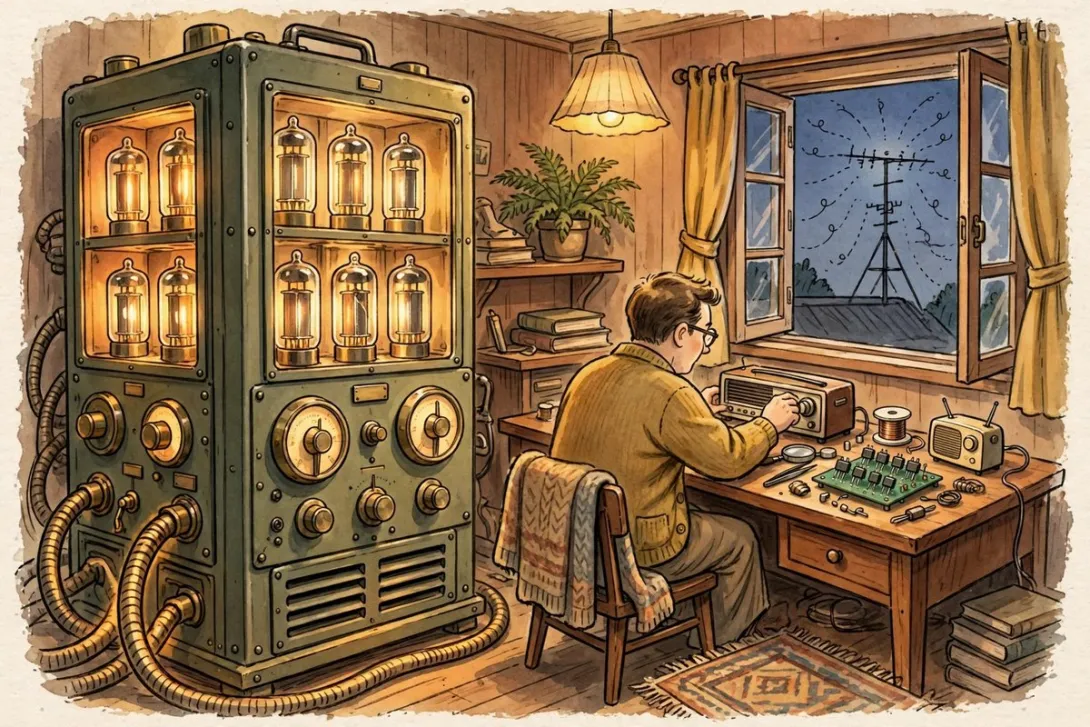
In 1947, the ham bands belonged to AM: big, warm signals sprawling across six kilohertz, from transmitters that glowed like space heaters and weighed as much as refrigerators. Then a strange new sound appeared — quacking, Donald Duck gibberish on the frequencies where experimenters were testing a mode that threw away the carrier and one entire sideband. Single sideband sounded awful on an ordinary AM receiver, but it carried a whisper around the world on a fraction of the power — and within two decades, with a little help from a speck of germanium, it would remake the ham shack.
The sideband story starts in print. In June 1948, QST carried Don Norgaard's (W2KUJ) "A New Approach to Single Sideband," and homebrewers took up the challenge; by April 1950, phasing-method builders outnumbered filter users two to one. Collins Radio supplied the key ingredient, the mechanical filter, and in March 1955 introduced the 75A-4 receiver and KWS-1 kilowatt transmitter — the first receiver marketed specifically for sideband. The pair cost so much that hams dubbed them "The Gold Dust Twins." Founder Art Collins (W0CXX) bet on the mode anyway, demonstrating SSB on Strategic Air Command flights that year; milestones followed, from the first sideband DXCC in 1955 to the first sideband WAC and WAS by November 1956 — though as late as 1963 a letter in QST urged the ARRL to ask the FCC to give "the a.m. boys six months to go s.s.b."
Meanwhile, a quieter revolution had begun in a New Jersey laboratory. In December 1947, John Bardeen, Walter Brattain, and William Shockley demonstrated the point-contact transistor at Bell Telephone Laboratories — a speck of germanium that did a vacuum tube's job without the heat, filament, or glass. Hams followed the semiconductor age in the magazines: Popular Electronics' monthly "Transistor Topics" column noted in April 1960 that more and more transistorized products were replacing tube designs. Ham radio's first taste was small. In late 1960 Heathkit produced the GW-30, a four-transistor handheld "walkie talkie" on a single small 9-volt battery. QST reviewed it that November, noting a range of about a mile but concluding it "certainly would come in handy" for civil defense work.
The two revolutions converged in Benton Harbor, Michigan. In 1964 Heathkit introduced the SB line — the SB-300 receiver, SB-400 transmitter, and SB-200 amplifier — built from the ground up for SSB, with no AM at all. The sets echoed Collins's S-Line; several Heath engineers behind them had come from Collins after military contract layoffs. Their Linear Master Oscillator, a pre-built and calibrated module, tuned within a couple hundred hertz. The SB-300 evolved into the SB-301, then the fully solid-state SB-303 — and the transistor began displacing tubes in full-size HF stations too.
Consider the distance traveled. Collins's own KW-1, a one-kilowatt AM transmitter, weighed 600 pounds and stood nearly six feet tall. A generation later, hams worked the world on sideband with a fraction of the power and bulk — and handhelds were slipping into shirt pockets. The fifties and sixties gave the hobby a new identity: from glowing bottles and booming carriers to precision, efficiency, and miniaturization.