Four years after Sputnik 1, a group of California amateurs decided the space age should not belong to governments alone. In December 1961, they put their own satellite in orbit — and it worked.
The story starts in January 1958, with the launch of Explorer 1, America’s first satellite. A small group of West Coast hams — Lance Ginner, K6GSJ; Chuck Smallhouse, W6MGZ; Ed Beck, K6ZX; Al Diem; Chuck Townes, K6LFH; and Nick Marshall, W6OLO — organized themselves into Project OSCAR, short for Orbiting Satellite Carrying Amateur Radio. Their goal: build a satellite, by amateurs, for amateurs.
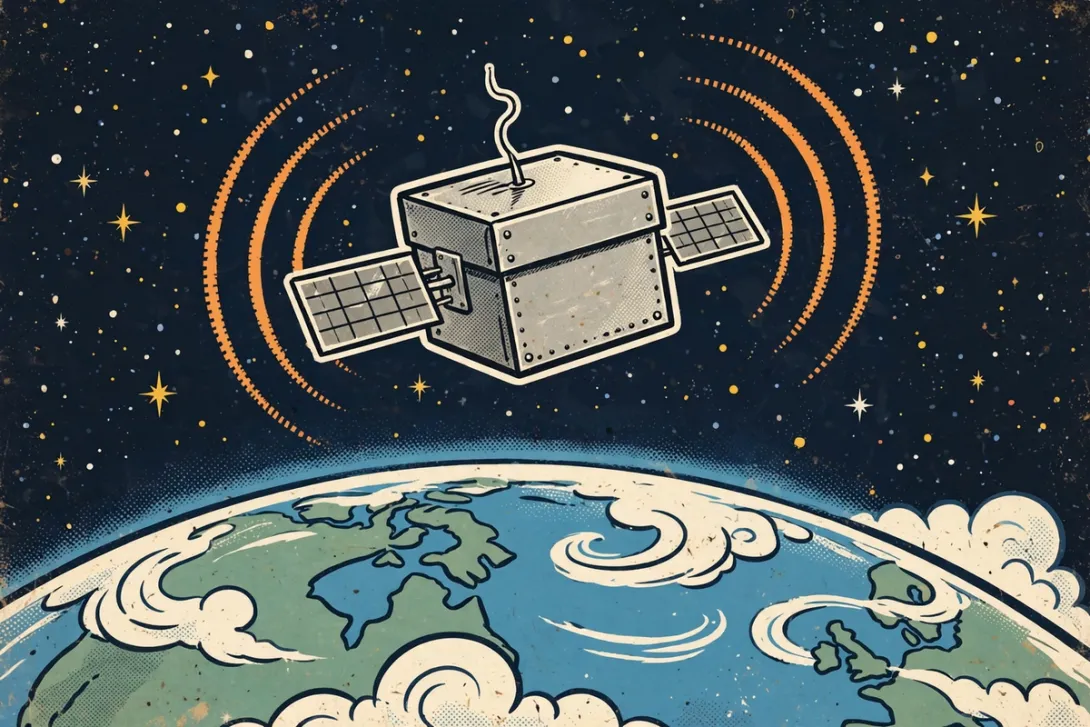
After long exchanges with ARRL and government agencies, they secured a ride most dreamers never get: their satellite would fly as ballast — a secondary payload — on a U.S. Air Force Thor-Agena launch. OSCAR 1 was a shoebox-sized rectangular box, about 30 by 25 by 12 centimeters, built in a garage workshop for a reported $63 in parts. Its payload was almost comically simple: a battery-powered 140-milliwatt transmitter on the 2-meter band at 144.983 MHz, feeding a 60-centimeter monopole antenna. It carried no instruments, no camera, no solar panels. It beeped.
On the morning of December 12, 1961, the Thor-Agena rose from Vandenberg Air Force Base carrying Discoverer 36 aloft — and OSCAR 1 along with it. Separated into its own orbit, the little satellite began transmitting its Morse message: “HI” — the international ham greeting — over and over, at a rate that shifted with the spacecraft’s internal temperature, teaching its builders their first lessons in satellite thermal design.
It worked far better than anyone expected. For about three weeks, until its batteries gave out in early January 1962, OSCAR 1 beeped away. More than 570 radio amateurs in 28 countries reported hearing it. Vice President Lyndon B. Johnson sent the Project OSCAR group a congratulatory telegram, calling the project symbolic of freedom of enterprise and freedom of participation. The satellite re-entered the atmosphere on January 31, 1962.
OSCAR 1 was the world’s first non-government satellite and the first spacecraft ever launched as a piggyback payload — beating the first commercial satellite, Telstar 1, to orbit by seven months. It launched the OSCAR program, which continues today under AMSAT, with 125 satellites assigned OSCAR numbers as of mid-2025. And every amateur satellite beacon that still identifies in Morse owes its greeting to that first “HI.”