Skip to header Skip to main navigation Skip to main content Skip to footer
Home
N5XBI
The Frequency of Forward Thinking

Main navigation

  • Home

FCC

Breadcrumb

  • Home
  • FCC

ISS SSTV Pictures Start Today as a G1 Storm Fades and CQ WW SSB Weekend Nears

The International Space Station in orbit above Earth, photographed by NASA.

The International Space Station starts sending pictures over amateur radio today. ARISS lists its Expedition 75 Series 34 slow-scan television event, themed “ARISS Hardware,” as beginning Thursday, October 22 at 15:30 UTC and concluding Sunday, October 25 at 18:00 UTC. The images will be transmitted at 437.55 MHz, plus or minus Doppler shift, in Robot 36 mode, with each transmission lasting 36 seconds followed by a two-minute gap. AMSAT-UK adds that the transmissions come from the amateur station in the ISS Service Module under the callsign RS0ISS.
  • Read more about ISS SSTV Pictures Start Today as a G1 Storm Fades and CQ WW SSB Weekend Nears

G1 Storm Likely Wednesday as RF Comments Close and HAARP Campaign Continues

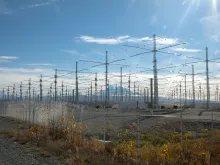
The HAARP antenna array at Gakona, Alaska, used for ionospheric research transmissions.

Wednesday, October 21, opens with unsettled to active conditions on the bands. In its 3-day forecast issued at 0030 UTC on October 21, NOAA's Space Weather Prediction Center said the greatest observed 3-hour Kp over the past 24 hours was 3, below storm levels, but the greatest expected Kp for October 21 through 23 is 4.67, which is G1 on the NOAA scale. Forecasters said G1 minor geomagnetic storming is likely on October 21 due to coronal hole high speed stream effects, with the highest forecast values, 4.67, in the 00-03 and 06-09 UTC periods today.

  • Read more about G1 Storm Likely Wednesday as RF Comments Close and HAARP Campaign Continues

HAARP Takes the Air for Rocket Missions as a G1 Storm Watch Peaks Tonight

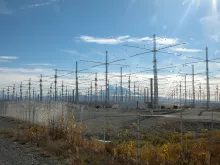
The HAARP antenna array at Gakona, Alaska, used for ionospheric research transmissions.

Tuesday, October 20, 2026 — If you hear an unusual signal sweeping the lower HF bands in the small hours this week, it may be Alaska. The High-frequency Active Auroral Research Program, HAARP, begins a five-day research campaign today, October 20, running through October 24 UTC in support of two sounding rocket missions from the Poker Flat Research Range, north of Fairbanks. The University of Alaska Fairbanks Geophysical Institute says HAARP will transmit daily from 0530 to 0930 UTC, with all transmissions between 2.8 and 10 MHz and frequencies varying as conditions dictate.

  • Read more about HAARP Takes the Air for Rocket Missions as a G1 Storm Watch Peaks Tonight

School Club Roundup Opens as G1 Storm Watch and CQ WW SSB Weekend Approach

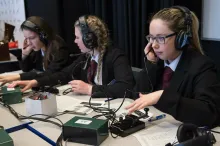
Three school students operating an amateur radio station during an ARISS contact with the International Space Station.

Monday, October 19, 2026, opens a busy week on the bands, led by the ARRL School Club Roundup. The fall session runs October 19 through 23, beginning at 1300 UTC Monday and ending at 2359 UTC Friday. School clubs from elementary school through university exchange contact information with each other and with any other station, and individuals and non-school clubs are encouraged to take part. A station may operate no more than six hours in any 24 hours and 24 hours total, so give young operators a contact when you hear them.

  • Read more about School Club Roundup Opens as G1 Storm Watch and CQ WW SSB Weekend Approach

From Class A to Family Radio: How GMRS Grew From a 1947 Experiment

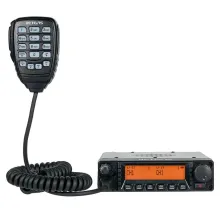
A Retevis GMRS mobile radio with its hand microphone, showing the channel display on the front panel.

GMRS began with a dream of radio for everyone. After World War II, inventor Al Gross demonstrated a pocket-sized UHF radio, and FCC Commissioner E. K. Jett championed a citizens radio service that would work almost like a telephone, quiet until someone called you. On April 10, 1947, the FCC created that service in the 460 to 470 MHz band and called it Class A Citizens Radio Service. The early gear was tube-type, limited to 60 watts of plate input power to the final amplifier tube, and it ran wideband FM with 50 kilohertz channel spacing.

  • Read more about From Class A to Family Radio: How GMRS Grew From a 1947 Experiment

Scouts Fill the Bands on JOTA Saturday as S9R Signs On From Sao Tome

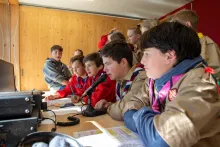
Scouts gathered around a desk microphone at a Jamboree on the Air amateur radio station

Saturday is the heart of Jamboree on the Air and Jamboree on the Internet, running October 16 to 18 under the theme A Peaceful and Inclusive World, and Scouts are on the air today. At Pacificon in San Ramon, California, the Golden Gate Area Council and the Mount Diablo Amateur Radio Club are running a JOTA-JOTI station at the San Ramon Marriott from 8:30 a.m. to 4:00 p.m. today, while Pacificon, the ARRL Pacific Division Convention, is in its second day. Across the country, Hamfest Chattanooga wraps up today, October 17, from 8 a.m. to 3 p.m.

  • Read more about Scouts Fill the Bands on JOTA Saturday as S9R Signs On From Sao Tome

Auction Opens, Scouts Take the Air: Pacificon and JOTA-JOTI Kick Off a Big Friday

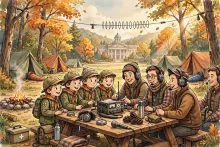
Cartoon illustration of Scouts and amateur radio operators at an outdoor radio station with tents, a dipole antenna between trees, and a convention hall behind them.

The 21st annual ARRL Online Auction opens today, Friday, October 16, and runs through October 22 with more than 200 items up for bid. This year's list includes gear featured in QST product reviews, vintage books, pre-owned equipment, and signed original sketches by Salty Walt Hudson, K4OGO, along with four mystery boxes from the ARRL Lab team. Featured equipment includes an Icom solid-state amplifier, an Alinco 2-meter FM transceiver, and an Elecraft QRP transceiver package. Proceeds benefit ARRL education programs that help license new hams and support continuing technical education.

  • Read more about Auction Opens, Scouts Take the Air: Pacificon and JOTA-JOTI Kick Off a Big Friday

When All Else Fails: How ARES and RACES Learned to Be Ready Before Disaster Strikes

Cartoon illustration of volunteer amateur radio operators running an emergency station at a table after a coastal storm, with neighbors receiving help nearby.

When Hurricane Katrina came ashore on August 29, 2005, near Buras, Louisiana, as a Category 3 storm with winds near 125 miles per hour, it knocked out power, telephones and much of the Gulf Coast's ordinary communications. In Hancock County, Mississippi, the county had lost contact with the outside world except through amateur radio operators, who stepped in as 911 dispatchers and relayed messages in and out. It was dramatic, but it was not improvised from nothing.

  • Read more about When All Else Fails: How ARES and RACES Learned to Be Ready Before Disaster Strikes

Quiet Bands Thursday, Then a Packed Weekend: JOTA-JOTI, Pacificon and S9R Arrive Friday

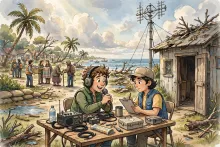
Cartoon illustration of Scouts and an amateur radio operator at a radio station with headphones, a microphone and radio waves around a globe

Good morning from N5XBI on Thursday, October 15. The bands should be calmer today after an unsettled start to the week. NOAA's Space Weather Prediction Center said in its October 14 discussion that solar activity stayed low, with departing Region 4549 producing C-class flares as large as C4.2 and C6.9, growing Region 4551 producing only low-level C-class activity, and newly numbered Region 4558 unremarkable. No Earth-directed coronal mass ejections were observed. SWPC expects low activity through October 16 with only a slight chance of an M-class flare, mainly from Region 4551.

  • Read more about Quiet Bands Thursday, Then a Packed Weekend: JOTA-JOTI, Pacificon and S9R Arrive Friday

From Packets to Whispers: How Digital Modes Learned to Do More With Less

Cartoon illustration of a ham radio shack with a vintage packet radio computer and a modern screen showing a colorful digital waterfall under a starry sky

In 1978, members of the Montreal Amateur Radio Club began sending ASCII data over VHF frequencies with homebuilt equipment, after Canadian authorities authorized the experiments. It was a bold idea for its time: instead of speaking into a microphone, a ham would let a computer chop a message into small bursts, send each burst with an address and error checking, and let the station at the other end reassemble it. When the United States Federal Communications Commission authorized ASCII transmissions for American amateurs in 1980, the experiment was ready to spread.

  • Read more about From Packets to Whispers: How Digital Modes Learned to Do More With Less

Pagination

  • Page 1
  • Next page ››
Subscribe to FCC

Copyright © 2026 Rocky Mountain Madman LLC - All rights reserved

Developed and Designed by Rocky Mountain Madman LLC