Skip to header Skip to main navigation Skip to main content Skip to footer
Home
N5XBI
The Frequency of Forward Thinking

Main navigation

  • Home

ARRL

Breadcrumb

  • Home
  • ARRL

Just Hussein on the Air: How King Hussein, JY1, Became Ham Radio's Most Famous Voice
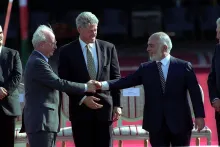
King Hussein of Jordan shaking hands with Israeli Prime Minister Yitzhak Rabin as President Bill Clinton looks on during the Israel-Jordan peace era

If you tuned across 20 meters in the 1970s, 1980s or 1990s and heard a pileup suddenly tighten with excitement, there was a good chance the station everyone wanted was in Amman, Jordan. The callsign was JY1, about as short and memorable as a callsign gets, and the operator was Hussein bin Talal, king of Jordan. On the air he did not trade on his title. Fellow operators remembered a courteous, curious man who simply loved a good conversation, and the ARRL, of which he was a life member, regarded him as arguably the most famous radio amateur in the world.
  • Read more about Just Hussein on the Air: How King Hussein, JY1, Became Ham Radio's Most Famous Voice

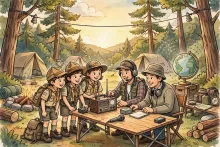
Auction Opens, Scouts Take the Air: Pacificon and JOTA-JOTI Kick Off a Big Friday

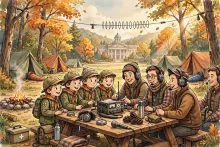
Cartoon illustration of Scouts and amateur radio operators at an outdoor radio station with tents, a dipole antenna between trees, and a convention hall behind them.

The 21st annual ARRL Online Auction opens today, Friday, October 16, and runs through October 22 with more than 200 items up for bid. This year's list includes gear featured in QST product reviews, vintage books, pre-owned equipment, and signed original sketches by Salty Walt Hudson, K4OGO, along with four mystery boxes from the ARRL Lab team. Featured equipment includes an Icom solid-state amplifier, an Alinco 2-meter FM transceiver, and an Elecraft QRP transceiver package. Proceeds benefit ARRL education programs that help license new hams and support continuing technical education.

  • Read more about Auction Opens, Scouts Take the Air: Pacificon and JOTA-JOTI Kick Off a Big Friday

When All Else Fails: How ARES and RACES Learned to Be Ready Before Disaster Strikes

Cartoon illustration of volunteer amateur radio operators running an emergency station at a table after a coastal storm, with neighbors receiving help nearby.

When Hurricane Katrina came ashore on August 29, 2005, near Buras, Louisiana, as a Category 3 storm with winds near 125 miles per hour, it knocked out power, telephones and much of the Gulf Coast's ordinary communications. In Hancock County, Mississippi, the county had lost contact with the outside world except through amateur radio operators, who stepped in as 911 dispatchers and relayed messages in and out. It was dramatic, but it was not improvised from nothing.

  • Read more about When All Else Fails: How ARES and RACES Learned to Be Ready Before Disaster Strikes

Quiet Bands Thursday, Then a Packed Weekend: JOTA-JOTI, Pacificon and S9R Arrive Friday

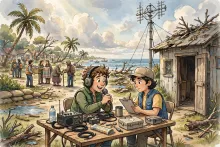
Cartoon illustration of Scouts and an amateur radio operator at a radio station with headphones, a microphone and radio waves around a globe

Good morning from N5XBI on Thursday, October 15. The bands should be calmer today after an unsettled start to the week. NOAA's Space Weather Prediction Center said in its October 14 discussion that solar activity stayed low, with departing Region 4549 producing C-class flares as large as C4.2 and C6.9, growing Region 4551 producing only low-level C-class activity, and newly numbered Region 4558 unremarkable. No Earth-directed coronal mass ejections were observed. SWPC expects low activity through October 16 with only a slight chance of an M-class flare, mainly from Region 4551.

  • Read more about Quiet Bands Thursday, Then a Packed Weekend: JOTA-JOTI, Pacificon and S9R Arrive Friday

Unsettled Bands Midweek, Then a Packed Weekend: JOTA, Pacificon and S9R Are Almost Here

Cartoon illustration of scouts and amateur radio operators at a portable campsite station with an antenna strung between trees

Good morning from the shack on Wednesday, October 14. If the bands sound a little restless today, the Space Weather Prediction Center has an explanation. In its October 13 forecast discussion, SWPC reported low solar activity, with Region 4549 producing a largest flare of only C1.2 early that morning and no new Earth-directed coronal mass ejections observed. Solar activity is expected to stay low through October 15, though forecasters put the chance of M-class flares at 35 percent.

  • Read more about Unsettled Bands Midweek, Then a Packed Weekend: JOTA, Pacificon and S9R Are Almost Here

G1 Watch for Tuesday as Solar Wind Picks Up; JOTA and S9R Lead a Busy Weekend

Cartoon illustration of amateur radio operators in a ham shack watching aurora glow through the window while solar wind swirls overhead

Tuesday opens with a geomagnetic storm watch in effect. NOAA's Space Weather Prediction Center expects mostly active conditions on October 13 and 14, with isolated G1 minor storming likely today as a coronal hole high-speed stream moves into a geoeffective position. A separate SWPC watch lists G1 as the highest level predicted for October 13, with no storm watch in effect for October 14, so HF operators should expect changeable high-latitude propagation and a chance of aurora at northern latitudes tonight.

  • Read more about G1 Watch for Tuesday as Solar Wind Picks Up; JOTA and S9R Lead a Busy Weekend

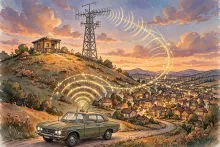
The Machine on the Hilltop: How FM Repeaters Remade Two Meters in the 1970s

Cartoon illustration of a 1970s hilltop amateur radio repeater tower relaying signals to a mobile operator in a car overlooking a town at dusk.

For most of its early life, two meters belonged to AM, CW, and homebrew rigs with modest range. A mobile station might reach a few miles on its own, and then geography won. The idea that changed everything was borrowed from commercial radio: put a receiver and a transmitter together on a hilltop or tall building, let the receiver listen on one frequency and the transmitter speak on another, and suddenly a small radio in a car could be heard across an entire city. FM, already proven by police, fire, and taxi fleets, gave the system clean, quiet audio to carry.

  • Read more about The Machine on the Hilltop: How FM Repeaters Remade Two Meters in the 1970s

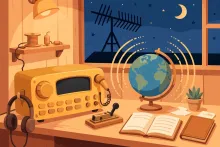
RTTY, Topband, and S9R: Your Week Ahead in Contests, DX, and Hamfests

A cartoon illustration of a cozy amateur radio shack desk with a transceiver, headphones, Morse key, logbook, a globe encircled by radio waves, and a beam antenna silhouetted against a starry night sky.

The weekend of October 17 and 18 is shaping up as one of the busiest on-air weekends of the fall, with a major digital contest, a 160-meter classic, and a fresh DXpedition to a rare Atlantic entity all landing on the same two days. Here is what to line up in your shack this week.

  • Read more about RTTY, Topband, and S9R: Your Week Ahead in Contests, DX, and Hamfests

G2 Storm Watch Lifted, Solar Flux Holds Near 120: Your Monday Radio Roundup

Cartoon illustration of an amateur radio operator at a desk looking up at a flaring cartoon sun over a small Earth, with radio waves connecting an antenna tower to the sun.

The Sun gave radio operators a breather this weekend. NOAA's Space Weather Prediction Center cancelled its G2 geomagnetic storm watch on October 11 — conditions no longer warranted it. This morning's 27-day outlook has the 10.7 cm solar flux at 120, the planetary A-index at 16, and the predicted Kp at 4. Sunday's observed flux was 122.

  • Read more about G2 Storm Watch Lifted, Solar Flux Holds Near 120: Your Monday Radio Roundup

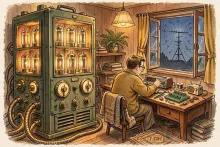
From Duck Talk to Gold Dust Twins: SSB and the Transistor Remade the Ham Shack

Cartoon illustration of a 1950s ham shack with a giant glowing vacuum-tube transmitter beside a tiny transistor radio on a wooden desk.

In 1947, the ham bands belonged to AM: big, warm signals sprawling across six kilohertz, from transmitters that glowed like space heaters and weighed as much as refrigerators. Then a strange new sound appeared — quacking, Donald Duck gibberish on the frequencies where experimenters were testing a mode that threw away the carrier and one entire sideband. Single sideband sounded awful on an ordinary AM receiver, but it carried a whisper around the world on a fraction of the power — and within two decades, with a little help from a speck of germanium, it would remake the ham shack.

  • Read more about From Duck Talk to Gold Dust Twins: SSB and the Transistor Remade the Ham Shack

Pagination

  • Previous page ‹‹
  • Page 2
  • Next page ››
Subscribe to ARRL

Copyright © 2026 Rocky Mountain Madman LLC - All rights reserved

Developed and Designed by Rocky Mountain Madman LLC