Skip to header Skip to main navigation Skip to main content Skip to footer
Home
N5XBI
The Frequency of Forward Thinking

Main navigation

  • Home

Radio History

Breadcrumb

  • Home
  • Radio History

One Hundred Years of the Yagi: The Antenna That Conquered the Rooftops
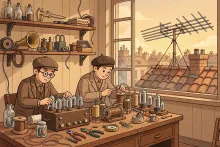
Cartoon of a 1920s laboratory with a classic multi-element Yagi beam on a rooftop

Look at any ham tower and you will know it instantly: the long boom, the row of elements getting shorter toward the front. The Yagi-Uda antenna turns 100 in 2026, and it remains the most recognizable antenna on Earth — the rooftop TV antenna of the 1960s, the contest station's beam, the direction-finder's pointer. A century after its invention, we still have not found a better way to aim radio waves.
  • Read more about One Hundred Years of the Yagi: The Antenna That Conquered the Rooftops

The Satellite That Refused to Die: AMSAT's Half Century of Ham Radio in Orbit

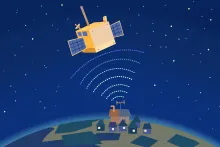
A cartoon illustration of a small home-built amateur radio satellite with solar panels and a whip antenna, radio waves arcing down to a rooftop ham antenna on a tiny house below, against a starry night sky

It began with a beep from a box of tin and wire. On December 12, 1961, barely four years after Sputnik, a group of California hams called Project OSCAR lofted the first amateur satellite, a battery-powered box that keyed "HI" in Morse on two meters until its batteries faded. That launch proved ordinary radio amateurs could put hardware in space, but a loose coastal club was no way to run a space program.

  • Read more about The Satellite That Refused to Die: AMSAT's Half Century of Ham Radio in Orbit

From Duck Talk to Gold Dust Twins: SSB and the Transistor Remade the Ham Shack

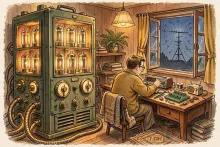
Cartoon illustration of a 1950s ham shack with a giant glowing vacuum-tube transmitter beside a tiny transistor radio on a wooden desk.

In 1947, the ham bands belonged to AM: big, warm signals sprawling across six kilohertz, from transmitters that glowed like space heaters and weighed as much as refrigerators. Then a strange new sound appeared — quacking, Donald Duck gibberish on the frequencies where experimenters were testing a mode that threw away the carrier and one entire sideband. Single sideband sounded awful on an ordinary AM receiver, but it carried a whisper around the world on a fraction of the power — and within two decades, with a little help from a speck of germanium, it would remake the ham shack.

  • Read more about From Duck Talk to Gold Dust Twins: SSB and the Transistor Remade the Ham Shack

OSCAR 1: How a Shoebox Satellite Built by Hams Became the First Private Spacecraft

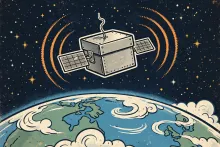
Cartoon illustration of a tiny shoebox-shaped satellite beeping above Earth in space.

Four years after Sputnik 1, a group of California amateurs decided the space age should not belong to governments alone. In December 1961, they put their own satellite in orbit — and it worked.

  • Read more about OSCAR 1: How a Shoebox Satellite Built by Hams Became the First Private Spacecraft

Bouncing Signals Off the Moon: 80 Years of Earth-Moon-Earth Communication

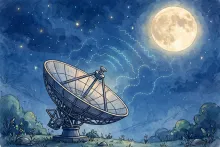
Cartoon illustration of a large dish antenna aimed at the moon in a starry night sky.

The moon is a terrible reflector of radio waves. It absorbs most of what hits it, returns only a whisper, and keeps moving the whole time. Amateurs have been bouncing signals off it for more than 70 years anyway.

  • Read more about Bouncing Signals Off the Moon: 80 Years of Earth-Moon-Earth Communication

From Class A to GMRS: 75 Years of the General Mobile Radio Service

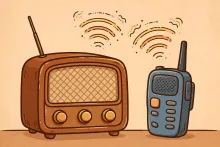
Cartoon illustration of a vintage 1940s tube radio beside a modern handheld two-way radio.

Ask most GMRS users where their service came from and you will get a shrug. But the General Mobile Radio Service is one of the oldest radio services the FCC ever created — older than CB, older than FRS, and nearly as old as amateur radio licensing itself.

  • Read more about From Class A to GMRS: 75 Years of the General Mobile Radio Service

Silenced Twice: How Two World Wars Took Hams Off the Air and Put Them in Uniform

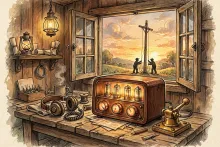
Cartoon illustration of a vintage 1940s ham radio shack with a glowing vacuum-tube receiver and telegraph key, while two figures outside the window lower an antenna mast at sunset.

In April of 1917, as the United States entered the First World War, every amateur radio operator in the country received the same grim letter from the Department of Commerce: get off the air and dismantle your antennas. More than six thousand hams, at the height of the spark era, fell silent almost overnight. The American Radio Relay League, formally organized that very year, suddenly had nothing to relay — so it did the next most useful thing it could think of: it recruited its members into the nation's communications services.

  • Read more about Silenced Twice: How Two World Wars Took Hams Off the Air and Put Them in Uniform

One Failed Message, 30 Miles, and the Birth of the American Radio Relay League

Cartoon illustration for the ARRL founding history article

One night in April 1914, Hiram Percy Maxim sat down at his one-kilowatt station in Hartford, Connecticut — call sign 1WH, one of the best-equipped amateur stations in New England — and tried to send a message to a fellow ham in Springfield, Massachusetts, just 30 miles away. Nothing came back. He called again. Still nothing. Then he remembered a ham he knew in Windsor Locks, roughly halfway between the two cities, and asked him to carry the message the rest of the way.

  • Read more about One Failed Message, 30 Miles, and the Birth of the American Radio Relay League

The Spark Era: How Marconi and the First Experimenters Gave Birth to Amateur Radio

Cartoon-style illustration for the spark era amateur radio article

Long before a modern ham station, with its whisper-quiet transistors and waterfall displays, there was thunder. The earliest radio transmitters worked by discharging a capacitor across a spark gap, and every dot and dash went out into the air riding a crackling bolt of artificial lightning. That violent, beautiful noise was the heartbeat of amateur radio's first era, and it began with a young Italian experimenter who believed he could make electricity speak without wires.

  • Read more about The Spark Era: How Marconi and the First Experimenters Gave Birth to Amateur Radio

Pagination

  • Previous page ‹‹
  • Page 2
Subscribe to Radio History

Copyright © 2026 Rocky Mountain Madman LLC - All rights reserved

Developed and Designed by Rocky Mountain Madman LLC